K-12
1/12 Update: Heading West
School disruptions slowed to start this week as the majority of the schools that were virtual last week did open back up for in-person learning....
In this week's Tracker, we cover school closure and consolidation discussions, CSI and TSI school improvement designations, and the role facility condition assessments play in district planning.
1. Burbio's Signals Tracker analyzes millions of pages of school board discussions, helping clients identify emerging issues and immediate selling opportunities. One ongoing issue in K-12 education is school closures and consolidations. Below is a map showing districts that have discussed the issue since March 1st:
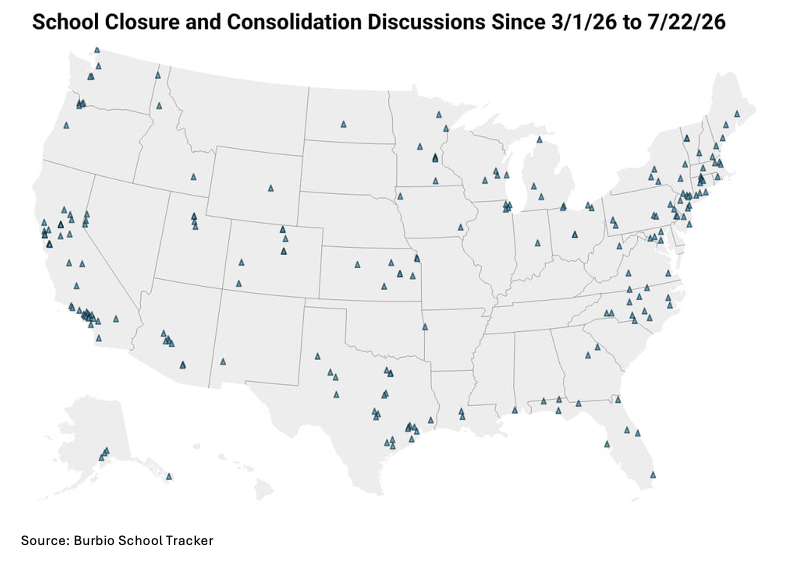
While every district approaches school closures somewhat differently, the overall sequence follows a similar pattern across the country:
While the sequence above is generally consistent, specific state laws can impact the timeline and requirements. Some states prescribe formal notice, public hearing, or equity review requirements before a school can close, while others leave much of the process to local board policy.
2. Burbio tracks schools identified for Comprehensive Support and Improvement (CSI) or Targeted Support and Improvement (TSI). Under federal ESSA guidelines, these designations identify low-performing schools eligible for additional School Improvement funding. States periodically re-identify schools based on ESSA accountability measures, and schools exit these designations only after meeting state-defined improvement criteria. Below are the North Carolina districts receiving the most School Improvement funding, along with the share of each district’s total federal revenue that the funding represents.
.png?width=857&height=528&name=unnamed%20(6).png)
3. Facility condition assessments are among the earliest stages of district construction planning. They typically occur well before construction begins and before an architect is selected, making them early indicators of capital projects. This information is available through both Burbio's Signals Tracker and Construction Tracker. We analyzed more than 600 district discussions of facility assessments across 48 states since April 1st to identify common themes.
Districts conduct facility condition assessments for several reasons:
While the scope varies by district, the assessment process generally follows a consistent pattern:
School disruptions slowed to start this week as the majority of the schools that were virtual last week did open back up for in-person learning....
Over half of US K-12 students now attend schools with traditional learning and less than twenty percent attend virtual-only schools. The new 3 feet...
Over sixty percent of US K-12 students now attend schools that offer traditional in-person learning and less than ten percent attend virtual only...