K-12
Burbio School Tracker 8/19: Points of Emphasis
This week we review state-level AI guidance, year-over-year comparisons in school budget terminology, recent bond activity, and school board...
This week we look at year-over-year changes in key board meeting discussions, a summary of the top five trends in district-level AI activity, state policy activity in the literacy area, and some recent RFPs. More below.
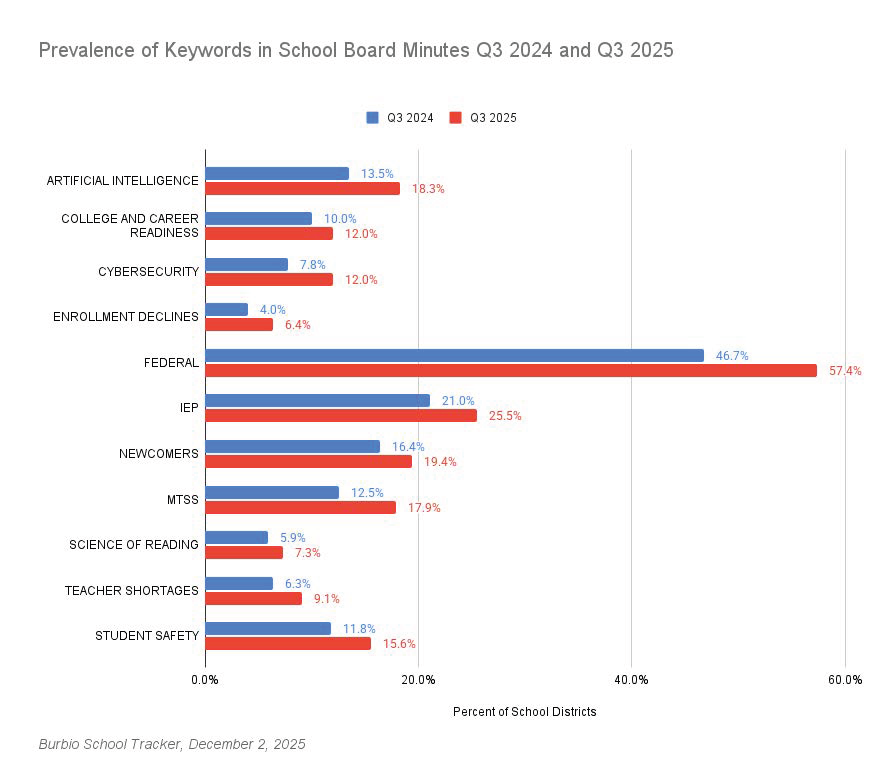
1. Burbio's foundational datasets include millions of pages of K-12 board meetings and strategic plans, and our work with clients uses finely tuned prompts to identify key signals from this data. This week we lens out and take a look at keyword trends from Q3 2024 to Q3 2025.
The analysis below covers districts with more than 5,000 students. In compiling this analysis we were struck by the increased rates of mentions of so many terms, not just ones you might expect such as Artificial Intelligence and Federal Funding:
2. Burbio detects tens of thousands of weekly AI-powered Signals on district-level activity, using prompts tailored to each client’s objectives. These insights can be highly tactical, highlighting emerging needs, upcoming purchase decisions, or district goals. Each summary includes links to the source document and is delivered to clients based on sales territories or marketing filters.
In addition to district-level signals this approach can identify broad market trends across this massive database. This week we summarize the top five trends in the fast-moving area of AI implementation and professional development. The following trends are taken from the last sixty days of board meetings:
Developing AI policies and guidelines
Establish acceptable use policies for students and staff covering areas such as academic integrity, ethics and safety. This includes issues such as plagiarism and cheating for students, AI-use disclosure requirements for staff, and privacy safeguards.
Professional development
Includes targeted professional development on generative AI, classroom applications, and the development of staff resources such as training modules, toolkits, example lessons. Classroom application subjects include using AI for differentiated learning, lesson design, and classroom materials, plus training on bias detection and ethics.
Integrating AI Literacy and 21st-Century Skills into the curriculum
Focus areas include developing age-appropriate guidance, workforce development, and programs incorporating AI literacy.
Establishment of AI working groups and partnerships
Formation of AI committees and task forces, including the use of outside consultants. This process also includes developing AI strategic plans.
Widespread evaluation and piloting of AI platforms and services
As noted in previous Trackers, districts are adopting AI-first tools, while also testing teaching platforms that include AI capabilities. Reviews are wide-ranging and cover capabilities, costs, and classroom applications, and districts are conducting multiple reviews at once.
3. Burbio's State Policy dashboard includes information such as state board meetings, budgets, Title I funds, state AI policies and curriculum lists, TSI/CSI schools, and more. Burbio summarizes state board of education meetings and highlights the issues covered. This week we highlight literacy policies being discussed in states across the country.
In Michigan, the state board approved a resolution urging the state legislature to mandate LETRS and evidence-based literacy instruction for all K-12 educators.
In Delaware, the state launched the Early Literacy Playbook at its recent professional learning day.
The New Hampshire State Board of Education's recent meeting features a ten-page presentation on the state of Mississippi's recent literacy gains titled "Building Sustainability to Close Achievement Gaps and Support Lasting Improvements in Literacy Outcomes," featuring the state's "Marathon Timeline" of literacy reforms dating back to 2013.
Indiana's recent board meeting featured a wide-ranging discussion of literacy initiatives, including the announcement of a pilot program for schools serving students in grades six through eight.
In Minnesota, a recent Curriculum Leaders Meeting included an extended presentation on Minnesota's READ Act.
4. Burbio now bundles RFPs into our PreK-12 Intelligence Hub datasets including state grants, school board meeting minutes, strategic plans, bonds, superintendent turnover, and more. Information is presented by category, speeding up the filtering for relevant opportunities for clients. Below are some RFPs for instructional materials from last week:
Boulder Valley School District, CO, is looking for Middle School Social Studies materials.
Washoe County School District, NV, has an RFP for World Language Instructional Materials.
Anne Arundel County Public Schools, MD, is sourcing a textbook and digital program for Modern World History.
Cobb County School District, GA, is soliciting bids for Astronomy instructional resources for grades K-12.
Spokane Public Schools, WA, is looking for German curriculum.
This week we review state-level AI guidance, year-over-year comparisons in school budget terminology, recent bond activity, and school board...
This week we present a look at cell phone ban discussions at district school board meetings, state-level activity as monitored through state board of...
With recent activity at the Federal level, this week we review district-level AI initiatives from California, discussions in board meetings related...