1. As part of our foundational district information dataset Burbio delivers state and district-level enrollment data, sourced from Federal reporting and integrated into every layer of our district analysis and policy dashboards. The Department of Education recently released enrollment figures for the 2024-25 academic year, and we continue with analysis this week.
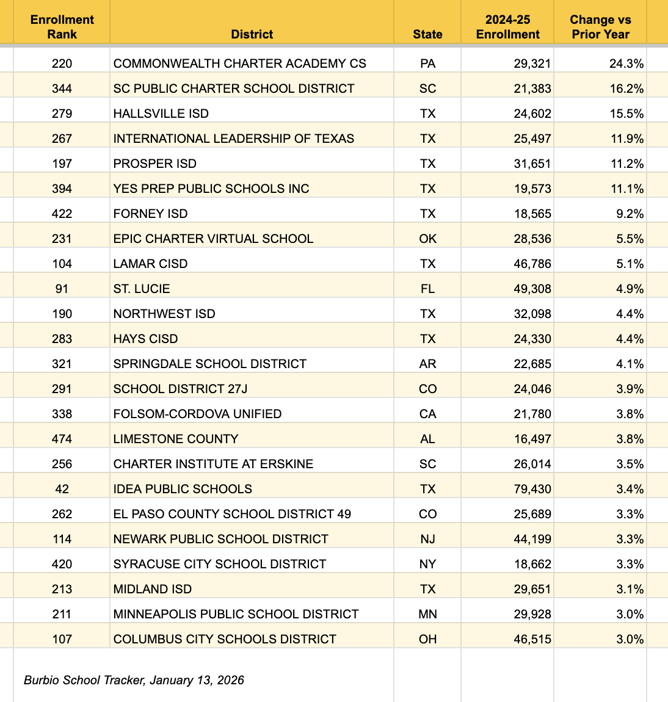
The chart below shows the fastest-growing districts in the country from the largest 500. The first column shows the rank of the district nationally; so for example Commonwealth Charter Academy is the 220th largest district in the country, and grew 24.3% year-over-year:
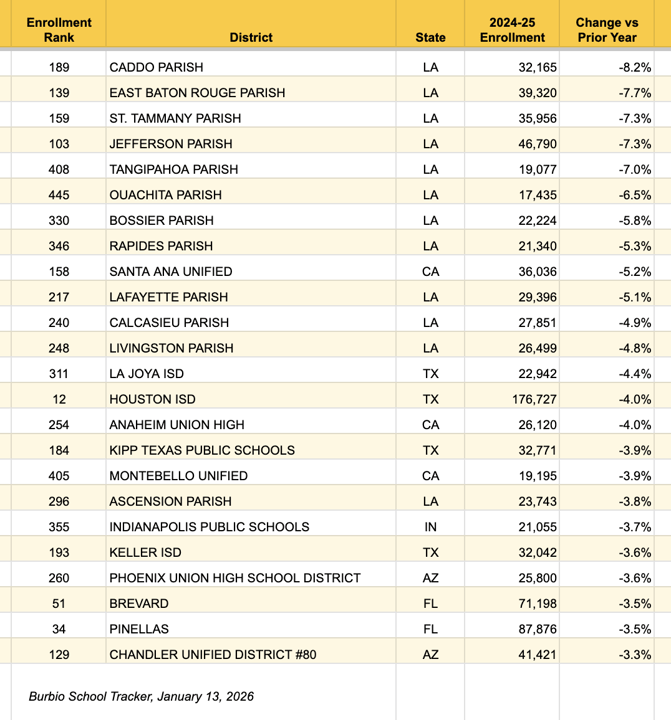
In last week's Tracker, we highlighted Louisiana's 5.9% enrollment decline as the highest among all states. The chart below shows the districts in the top 500 with the largest year-over-year declines; you will notice how many of those are in Louisiana:
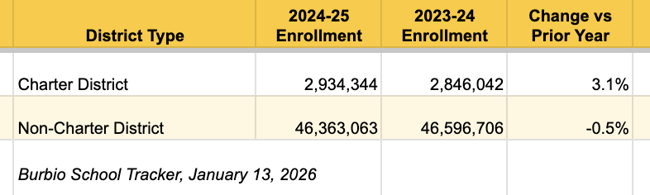
2. In our first chart above showing the 25 fastest-growing districts in the Top 500, six are designated as public charter districts by NCES. In seeing that we thought it would be interesting to do a broader analysis of changes in public charter enrollment over the last year. The following chart breaks out the enrollment changes by public charter and non-charter nationally during the period:
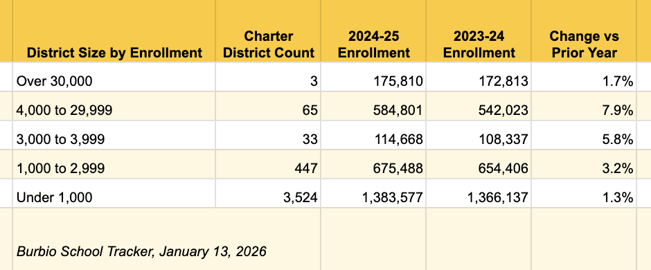
The following chart shows enrollment trends by charter district size with districts between 3,000 and 30,000 currently growing at the fastest rates:
3. Burbio's Signals Tracker reads millions of pages of district discussions and summarizes them for clients, who use the information to identify immediate selling opportunities. The Signals can be pulled into CRMs via API and combined with client's proprietary AI models.
This week, we analyze Signals from the past 90 days to identify the top five trends in how districts are addressing staffing issues and special education:
-
Focus on hiring and funding mandated positions for special education paraprofessionals, instructional assistants, and aides, often specifically designated as 1:1 support required by student IEPs. Discussions often refer to the need for additional FTE positions in these roles to maintain student-to-adult ratios amid increasing enrollment.
-
Districts heavily rely on external agencies and vendors to provide specialized services for IEP compliance, often filling internal staffing gaps. Examples include Speech-Language Pathologists (SLPs), Occupational Therapists (OTs), Physical Therapists (PTs), and nursing staff.
-
Implementing strategies to combat high turnover and staff shortages in special education, particularly for teachers and SLPs. Actions include seeking approval for waivers to hire staff lacking full certification, engaging in "Grow Your Own" programs, increasing stipends for paraprofessionals or special education staff, and conducting audits to analyze workload and efficiency.
-
Districts are creating and staffing specialized roles focused on behavior management. This involves hiring Registered Behavior Technicians (RBTs), Board Certified Behavior Analysts (BCBAs), and specialized social workers/counselors.
-
Program Restructuring and Staff Training for Compliance and Inclusion: Districts will overhaul special education service delivery models, implement Multi-Tiered Systems of Support (MTSS), and improve staff capacity, including things like conducting internal program and budget reviews to align resources with legal mandates (IDEA compliance).
4. We end this week with a summary of district concerns about AI implementation. The following top five concerns were taken from hundreds of district discussions during November and December of 2025:
-
Academic Integrity: Districts are actively evaluating how to ensure student work is authentic, as teachers are spending significant time determining if submissions are AI-generated. Many have implemented policies prohibiting students from presenting AI-generated work as their own without permission.
-
Impact on Student Cognition and Critical Thinking: There is a significant fear that an over-reliance on AI will act as a "crutch" rather than a tool, hindering the development of core fundamentals and higher-order thinking skills.
-
Data Privacy and Security: Ensuring compliance with privacy laws (such as FERPA and COPPA) is a critical priority, as districts are focused on vetting AI tools for their cybersecurity protections and ensuring they do not compromise student or staff privacy.
-
Ethical Use and Bias: Districts are concerned about the societal biases inherent in AI algorithms and the potential for misinformation, including the biases present in AI detectors themselves. Districts are incorporating "AI bias detection" into professional development to help teachers and students critically evaluate AI-generated outputs.
-
Safety and Digital Misuse: The rise of applications such as the creation and distribution of deepfakes and synthetic media is a safety concern. Some districts establish "AI Misuse" policies.